Read Policing Hatred: Law Enforcement, Civil Rights, and Hate Crime (Critical America) by Jeannine Bell Online
Read * Policing Hatred: Law Enforcement, Civil Rights, and Hate Crime (Critical America) PDF by * Jeannine Bell eBook or Kindle ePUB Online free. Policing Hatred: Law Enforcement, Civil Rights, and Hate Crime (Critical America) Provocative & Engaging Policing Hatred examines the important issue of hate crimes from a new vanatage point -- the cops on the beat, whose actions and decisions will affect significantly the judicial process. Bell's study of how and why police charge crimes as hate crimes is facinating, very well-written, and accessible to anyone interested in law and political science.. Scholarly but engaging A Customer Professor Bell carefully chronicles the work of a hate crime unit in a major metropolitan a
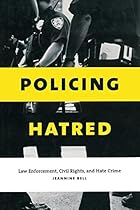
| Title | : | Policing Hatred: Law Enforcement, Civil Rights, and Hate Crime (Critical America) |
| Author | : | |
| Rating | : | 4.37 (675 Votes) |
| Asin | : | 0814798985 |
| Format Type | : | paperback |
| Number of Pages | : | 227 Pages |
| Publish Date | : | 2017-09-13 |
| Language | : | English |

Bell’s vivid evidence from the field argues persuasively for the need to have the police diligently address even low-level offenses, such as vandalism, given their devastating cumulative effects on society.. Drawing on her unprecedented access to a police hate crime unit, Bell’s work brings to life the stories of female, Black, Latino, and Asian American detectives, in addition to those of their white male counterparts. Policing Hatred also explores the impact of victim’s identity on each officers handling of bias crimes and addresses how the police treat defendants’ First Amendment rights. The nation’s attention has recently been focused on high-profile hate crimes such as the dragging death of James Byrd and the torture-murder of Matthew Shepard. Bell exposes the power that law enforcement personnel have to influence the social environment by showing how they determine whether an incident will be charged as a bias crime. The study of hate crimes challenges common assumptions regarding perpetrators and victims: most of the accused tend to be white, while most of their victims are not.Policing Hatred is an in-depth ethnographic study of how hate crime law works in practice, from the perspective of those enforcing it. It examines the ways in which the police handle bias crimes,
Provocative & Engaging Policing Hatred examines the important issue of hate crimes from a new vanatage point -- the cops on the beat, whose actions and decisions will affect significantly the judicial process. Bell's study of how and why police charge crimes as hate crimes is facinating, very well-written, and accessible to anyone interested in law and political science.. Scholarly but engaging A Customer Professor Bell carefully chronicles the work of a hate crime unit in a major metropolitan area. Her work offers careful detail of the type of crimes encountered, decisions investigate and charge suspects, and even the varied outlook of different cops within the unit.At the same time, Bell keeps her narrative grounded in real cases and real injuries. The result is a detailed analysis that remains engaging and compelling,. A Customer said lots of detail but not enough surprise. The book contains quite a bit of detail reflecting the author's ability for efficient and focused research. But the questions that she is pursuing, while potentially interesting to lay audiences and certainly socially important, aren't especially insightful, and accordingly, neither are the answers that she provides for them. The task that the author has set for herself is one that demands a strong propensity for the ac
. Steven Puro, St. Supreme Court analysis of First Amendment religious practices and relations between religious institutions and governmental activities. He shows how the "wall" metaphor represents a struggle for religious liberty and in a similar fashion has been used as a component of a strict separation policy between church and state. Dreisbach (justice, law, and society, American Univ.) demonstrates the underpinnings and both 19th- and 20th-century interpretations of this pervasive metaphor, which began as a phrase in a letter Jefferson wrote to the Danbury, CT, Baptist Association in 1802. This historical analysis offers new insight into the foundations of church-state discourse in the United States while also providing documentary underpinnings to Phillip Hamburger's analysis of 17th- to 19th-century religious writings in Separation of Church and State. Louis Univ. From Library Journal P
She is the author of Policing Hatred: Law Enforcement, Civil Rights, and Hate Crime; Police and Policing Law; and Gaining Access to Research Sites: A Practical and Theoretical Guide for Qualitative Researchers (with Martha Feldman and Michele Berger). . Jeannine Bell is Professor of Law at IU Maur
Download Policing Hatred: Law Enforcement, Civil Rights, and Hate Crime (Critical America)
Download as PDF : Click Here
Download as DOC : Click Here
Download as RTF : Click Here